
EXPERIMENTAL DEVELOPMENT OF MECHANOCHEMICAL KINEMATIC MODELS
CHEMISTRY & GREEN CHEMISTRY
Lab: CEMES
Duration: NanoX master Internship (8 months part-time in-lab immersion)
Latest starting date: 01/10/2026
Localisation: CEMES
29 Rue Jeanne Marvig
31055 TOULOUSE - FRANCE
Supervisors:
Dominik LUNGERICH, dominik.lungerich@cemes.fr
Nicolas BREFUEL nicolas.brefuel@cemes.fr
Work package:
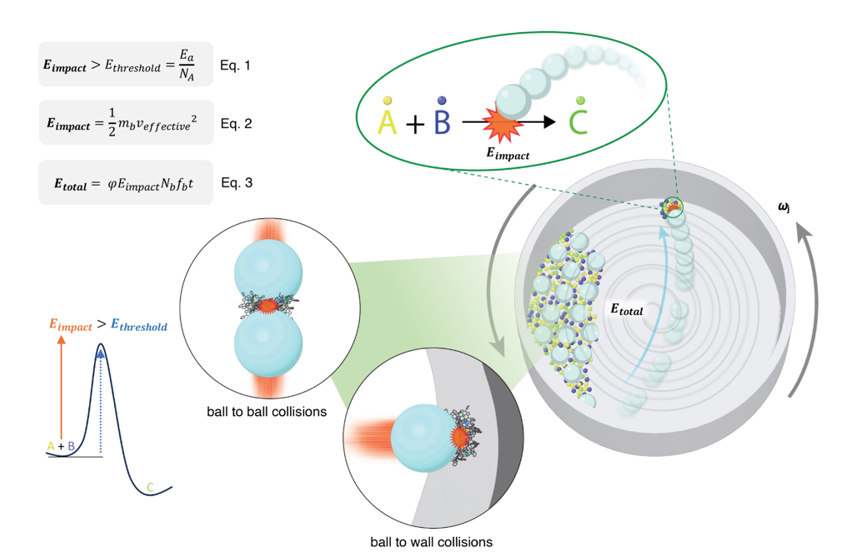
Initiating chemical reactions requires the overcoming of activation barriers that are intrinsic to each process. Conventionally, this occurs in solution by applying energy in the form of heat, light, or electricity. Along with developing environmentally friendly processes and increasing restrictions limiting the use of certain classes of chemicals, solvent-free alternatives, such as mechanochemistry, are attracting considerable research interest. By using mechanical energy,[1] modern high-energy ball mills have revolutionized the domain of mechanochemistry, paving the way for academia and the fine chemical industry to unseen efficiencies, improved sustainability, and novel reaction paradigms.
The objective of this project is to experimentally verify kinematic energy models and to advance the theoretical understanding of energy transfer mechanisms in mechanochemistry, in order to transform mechanochemistry into a scalable and reproducible tool for synthetic chemistry.
To this end, a high-speed planetary ball mill will serve as the primary tool to drive chemical transformations predominantly in the solid state. Particular attention will be given to predicting reaction outcomes by correlating the experimental results with theoretical predictions and further optimizing existing models to enhance synthetic reproducibility in mechanochemistry. These findings will have significant impact on the emerging field of mechanochemical synthesis, green chemistry, and physicochemical understanding of reaction kinetics in the solid state.
Objectives and Specific Training Elements
• Learn the principles of mechanochemistry and solvent-free synthesis, including how mechanical energy can overcome activation barriers.
• Operate high-speed planetary ball mills to drive solid-state chemical transformations.
• Evaluate and develop mathematical kinematic models and transform them into ready-to-use tools.
• Develop skills in designing, executing, and analyzing sustainable synthetic strategies at the molecular level.
References:
References:
- [1] O. F. Jafter, S. Lee, J. Park, C. Cabanetos, D. Lungerich, “Navigating Ball Mill Specifications for Theory-to-Practice Reproducibility in Mechanochemistry” Angew. Chem. Int. Ed. 2024, 63, e202409731.
Areas of expertise:
Organic Synthesis • Mechanochemistry • Kinematic Modelling • Green Chemistry • Reaction Kinetics
Required skills for the internship:
Experience in synthetic organic chemistry laboratories • Data analysis software (e.g., Excel, Origin, Matlab etc.) • Python coding (beneficial, but not required)