
SYNTHESIS OF BIO-INSPIRED LANTHANIDE-PEPTIDE CATALYSTS
CHEMISTRY & GREEN CHEMISTRY
Lab: LCC
Duration: NanoX master Internship (8 months part-time in-lab immersion)
Latest starting date: 01/10/2026
Localisation: Laboratoire de chimie de coordination (LCC) du CNRS
205 Rte de Narbonne, 31400 Toulouse
Supervisors:
Émilie MATHIEU emilie.mathieu@lcc-toulouse.fr
Work package:
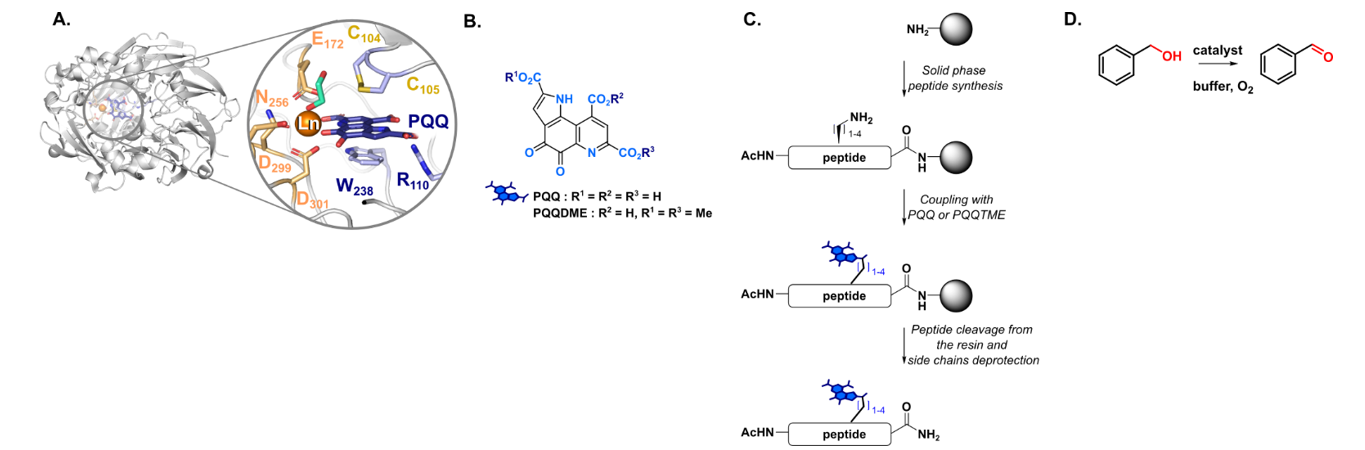
Enzymes are a source of inspiration to tackle societal challenges, particularly in the field of sustainability. The excellent and rarely matched performance of metalloenzymes stem from their high sophistication. An example is the lanthanide-dependent methanol dehydrogenase (Ln-MDH), which can oxidise methanol under ambient conditions, and hosts in its active site a Ln3+ ion and a pyrroloquinoline quinone (PQQ, Figure 1.A,B).[1-3] This reaction is important because it formally corresponds to the release of one hydrogen molecule (H2) from methanol. Understanding how Ln-MDH catalyses this transformation could contribute to the achievement of reversible H2 storage in liquid organic carriers such as methanol.[4] However, the enzyme itself is difficult to produce and study. Therefore, the alternative approach proposed in this project is to synthesize and study the reactivity of mimics of the enzyme in order to identify the parameters essential for its activity.
References:
[1] Falcone, E.*; Mathieu, E.*; Hureau, C. Lanthanide-binding peptides and proteins: coordination properties and applications. Chem. Soc. Rev. 2025, Advance Article [2] Daumann, L. J. Essential and Ubiquitous: The Emergence of Lanthanide Metallobiochemistry. Angew. Chem. Int. Ed. 2019, 58 (37), 12795–12802 [3] Featherston, E. R.; Cotruvo, J. A. The Biochemistry of Lanthanide Acquisition, Trafficking, and Utilization. Biochim. Biophys. Acta BBA - Mol. Cell Res. 2021, 1868 (1), 118864. [4] Prechtl, M. H. G.; Apfel, U.-P. Toward Electrocatalytic Chemoenzymatic Hydrogen Evolution and Beyond. Cell Rep. Phys. Sci. 2021, 2 (11), 100626
Areas of expertise:
The selected candidate will work in a stimulating, dynamic, and international environment at the Laboratoire de Chimie de Coordination du CNRS in Toulouse, France, within the team ALAMBIC.
Required skills for the internship:
We are seeking highly motivated candidates with a background in organic synthesis.
Please send a cover letter, your CV, and the names of two references to emilie.mathieu@lcc-toulouse.fr