
DEVELOPMENT OF LIQUID CRYSTALLINE NANOPARTICLES
CHEMISTRY & GREEN CHEMISTRY
Lab: IMRCP
Duration: NanoX master Internship (8 months part-time in-lab immersion)
Latest starting date: 05/10/2026
Localisation: Softmat 2 R.1, 236 Cr Eugène Cosserat 1er et 3e étages, 31400 Toulouse
LGC - 4 Allée Emile Monso CAMPUS INP – ENSIACET, 31400 Toulouse
Supervisors:
Barbara LONETTI barbara.lonetti@utoulouse.fr
Diana CIUCULESCU-PRADINES eliza.ciuculescu-pradines@utoulouse.fr
Work package:
Development of liquid crystalline nanoparticles
Internship
supervisor(s)
name: Barbara Lonetti, researcher ; Diana Ciuculescu-Pradines, assistant professor and Mallorie Tourbin,
assistant professor
e-mail: barbara.lonetti@utoulouse.fr; eliza.ciuculescu-pradines@utoulouse.fr; mallorie.tourbin@toulouse-
inp.fr
group: Ideas and IRPI teams
Location
Laboratory: Chemistry of colloids, polymers & complex assemblies
Softmat – UMR 5623
Laboratory: Laboratoire de Genie Chimique
LGC– UMR 5503
This research master's degree research project could be followed by a PhD It will depend on the
responses to the funding applications submitted
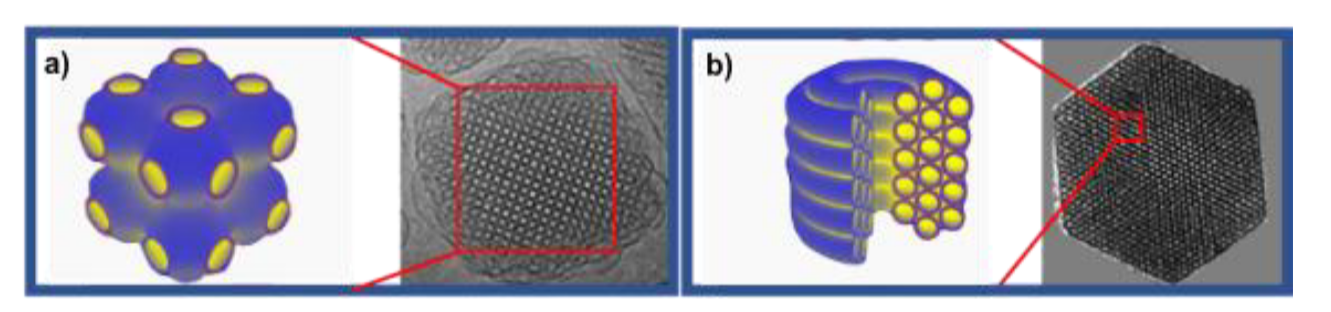
Liquid crystalline nanoparticles (LCN), particularly cubosomes and hexosomes, have attracted strong interest due
to their stability, encapsulation capacity, sustained release properties, templating properties for the synthesis of
various functional materials, which are highly relevant for drug delivery and material synthesis 1,2. Their internal
organization is characterized by highly stable structures combining hydrophobic regions with aqueous channels,
capable of encapsulating both hydrophilic and hydrophobic species. Both lipid and copolymer can be formulated
as LCN 3,4.
Conventional top-down and bottom-up strategies are already available for producing LCNs from lipids, and these
approaches are now beginning to be successfully applied to amphiphilic block copolymers. However, to overcome
some of the limitations associated with these conventional methods, the development of alternative processes
such as spray-drying is being considered.5 This technique offers significant advantages for generating dry LCN
precursor powders through atomization-drying, facilitating storage, transport, and long-term stabilization. This
internship will be carried out in two laboratories: SoftMat, which develops lipid- and copolymer-based LCNs using
conventional methods, and LGC-ENSIACET, which is developing the spray-drying approach.
The tasks assigned to the student will include:
i) Preparation and characterization of lipid-based LCNs, in close connection with the systems currently developed
within the SoftMat laboratory.
ii) Synthesis and characterization of biobased, biodegradable block copolymers via ring-opening polymerization
(ROP), with compositions specifically tailored for the formation of cubosomes and hexosomes.
iii) Evaluation of the copolymers for cubosome and hexosome formation using conventional preparation
methods.
iv) Production of LCN precursor powders by spray-drying, using systems adapted from the conventional approach.
The main characterization techniques that will be employed are: Transmission and Scanning Electron Microscopy
(TEM, SEM), Small-Angle X-Ray Scattering (SAXS), Dynamic Light Scattering (DLS) for the characterization of the
assemblies, and NMR, Size Exclusion Chromatography (SEC), and Differential Scanning Calorimetry (DSC) for the
characterization of the polymers.
References:
References:
[1] Thorn et al., J. Control. Release (2020) 319, 168; [2] Xie, et al. Adv. Mater. (2024) 36, 2313920 ; [3] Barriga et al., Angewandte Int Ed.
(2019) 58, 2958 ; [4] Chen et al Macromolecular Rapid Comm (2021) 42, 2100194 ; [5] Kaur et al., JPRI, 33, 118 (2021), Article no.
JPRI.69953.
Areas of expertise:
Liquid crystalline nanoparticles, polymer science, colloids, spray-drying
Required skills for the internship:
The skills required are in the field of chemistry, materials and physical chemistry. Scientific curiosity and
social skills will be appreciated.