

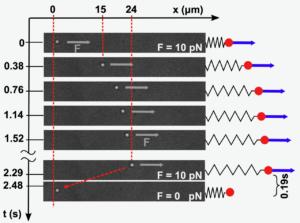
Fig : Elastic recoil in mucus. A constant force of 10 pN is applied to a 1 micron particle in a mucus gel. The particle undergoes viscoelastic deformation, and upon removal of the force it rapidly returns back to its initial position — indicating memory retention in the material even after large deformations. This data was collected in collaboration with Prof. Nuris Figueroa-Morales from the University of Colorado Boulder.
Principal Investigator : Wylie AHMED
Lab : LPT / Statistical Physics of Complex Systems
Mucus is a polymer gel that acts as a protective barrier in many biological systems, yet its
physical properties are not well understood. Recent work shows that mechanical stress can
induce persistent anisotropy and structural memory, implying that transport depends on
deformation history. In the body, mucus is continuously subjected to directional stresses, for
example from ciliary beating. This project will study mucus as a multiscale, anisotropic,
memory-bearing material, focusing on how shear history programs its mechanical and
transport properties. Using holographic microscopy, optical-tweezer microrheology, and
microfluidic shear control, we will measure direction-dependent viscoelasticity from virus-
sized particles to micron-scale colloids, and combine these measurements with theory
coupling nematic elasticity and viscoelastic hydrodynamics to establish physical principles
governing path-dependent transport in mucus.