
CARBON NANOMATERIALS FOR CRISPR GENOME EDITING
CHEMISTRY & GREEN CHEMISTRY

Lab: LCC
Duration: NanoX master Internship (8 months part-time in-lab immersion)
Latest starting date: 05/10/2026
Localisation: Laboratoire de Chimie de Coordination (LCC) campus at 205 Route de Narbonne, and ENSIACET at 4 Allée Emile Monso at INP campus
Supervisors:
Bidyut BIKASH SARMA bidyut-bikash.sarma@lcc-toulouse.fr
Julien PIRRELLO julien.pirrello@toulouse-inp.fr
This research master's degree project could be followed by a PhD
Work package:
Nanotechnology is rapidly transforming plant science serving as nanopesticides, nanofertilizers, and enabling genome editing. However, there remains a fundamental and persistent bottleneck in plant transformation: the inefficiency and imprecision of current plant genetic transformation methods. This bottleneck is not merely a technical hurdle; it is a primary constraint in the entire R&D pipeline, from fundamental gene function discovery to the applied development of advanced biotechnological tools essential for global food security and climate change adaptation.2 Through NanoX program, we propose to investigate the application of carbon nanomaterials, such as carbon nanotubes and hollow carbon nanospheres to develop a nanotechnology based tool kit for CRISPR genome editing in plants.3
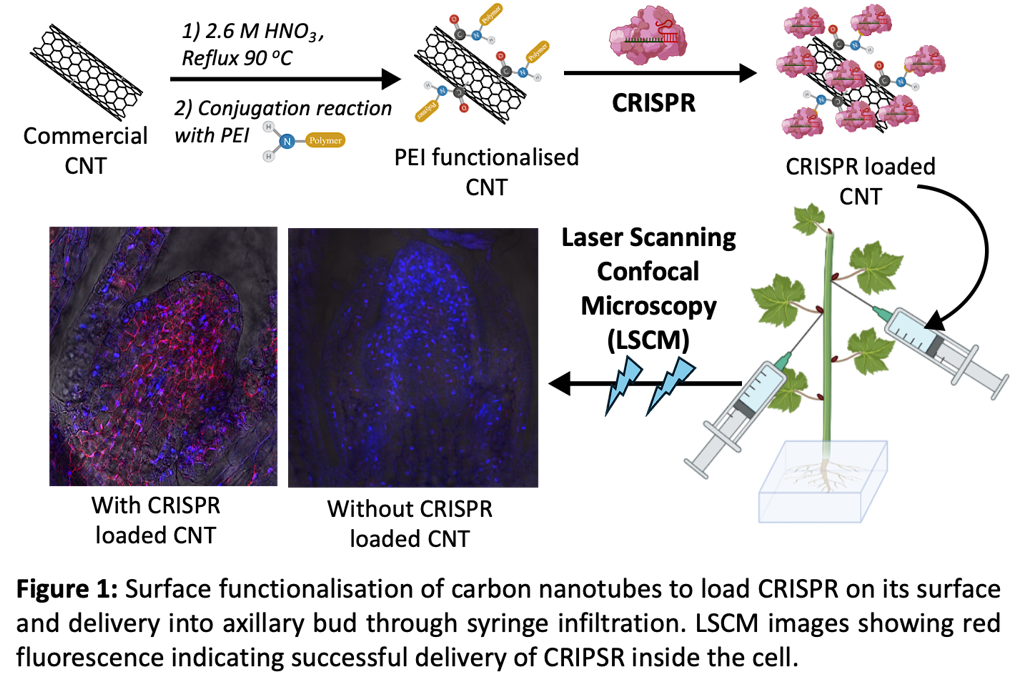
In this project, surface-functionalised carbon nanomaterials will be synthesised to allow an efficient conjugation of genetic materials (CRISPR) on their surface, while protecting against degradation and enabling cellular delivery. Analytical techniques like DLS & Zetasizer, agarose gel electrophoresis, and TEM will be used to investigate the encapsulation of CRISPR by carbon nanomaterials. This nanoassembly of carbon nanomaterial and CRISPR will be delivered inside the plant cell using syringe and vacuum infiltration into multiple plant tissues, such as axillary buds and callus. This will be followed by laser scanning confocal microscopy (LSCM) to determine their internalization into cell to confirm the successful delivery by the carbon nanomaterials to establish the proof-of-concept (Figure 1).
References:
1) The Plant Journal 122, no. 2 (2025): e70117. DOI
2) Current opinion in biotechnology 91 (2025): 103241. DOI
3) Trends in Plant Science 30, no. 3 (2025): 249-268. DOI
Areas of expertise:
Carbon nanomaterials, Plant transformation, CRISPR Genome Editing.
Required skills for the internship:
Background in chemistry, knowledge in CRISPR genome editing will be advantageous.