
DESIGN AND EVALUATION OF CHIRAL STABILIZING AGENTS FOR ZNO NANOPARTICLES FORMATION
NANOSCIENCE
Lab: LCC
Duration: NanoX master Internship (8 months part-time in-lab immersion)
Latest starting date: 05/10/2026
Localisation: LCC Équipe Nanochimie, organisation et capteurs (équipe T)
205 route de Narbonne, BP 44099
31077 Toulouse cedex 4, Franc
Supervisors:
Myrtil KAHN myrtil.kahn@lcc-toulouse.fr
Béatrice GERLAN beatrice.gerland@utoulouse.fr
This research master's degree project could be followed by a PhD
Work package:
https://www.lcc-toulouse.fr/nanochimie-organisation-et-capteurs-equipe-t/
DESIGN AND EVALUATION OF CHIRAL STABILIZING AGENTS FOR ZNO NANOPARTICLES FORMATION
Internship supervisor(s)
Dr Myrtil KAHN, myrtil.kahn@lcc-toulouse.fr, Laboratoire de chimie de coordination LCC
Dr Valérie Sartor, valerie.sartor@utoulouse.fr, SOFTMAT
Dr. Béatrice GERLAND, beatrice.gerland@utoulouse.fr, LSPCMIB
Location
LCC Équipe Nanochimie, organisation et capteurs (équipe T)
205 route de Narbonne, BP 44099
31077 Toulouse cedex 4, France
This research master's degree research project could be followed by a PhD ☒ YES ☐ NO
During the synthesis of nanoparticles (NPs), surfactants primarily act as ligands for species in solution but are
also involved in NP growth, thereby influencing their final properties, such as size, morphology, polydispersity, and
surface structure. A deeper understanding of these surfactants role is essential to control NP properties and,
consequently, their potential applications, ranging from optoelectronics to biomedical imaging.[1]
Zinc oxide nanoparticles (ZnO NP), considered non-toxic, have generated significant interest, as evidenced
by the emergence of antibacterial [2] and chiral ZnO NP,[3] achieved through the use of biomolecules such as amino
acids[4] as surfactants.
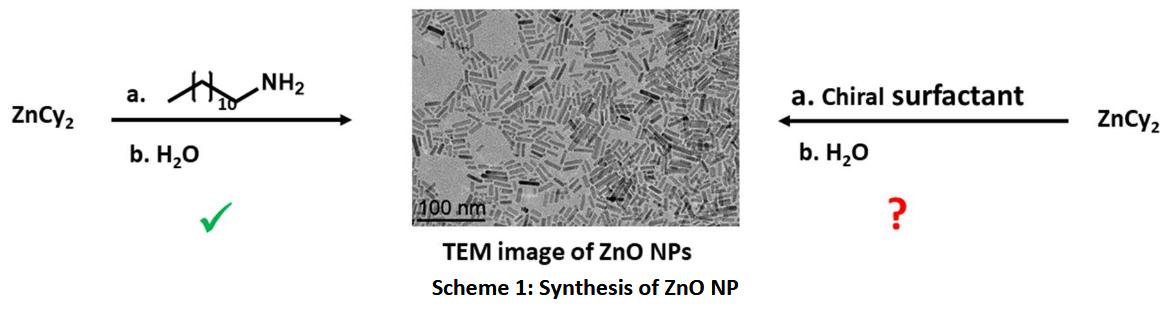
Moving beyond conventional sol-gel processes for ZnO NP synthesis, M. Kahn’s team of Coordination Chemistry
Laboratory (LCC) has developed a "safe-by-design" synthesis based on the controlled hydrolysis of the
organometallic precursor ZnCy₂ in the presence of the surfactant dodecylamine (DDA), thereby highlighting the
role of primary amines in ZnO NP growth (Scheme 1).[5]
This project aims to screen surfactants bearing a primary amine function, either from the chiral pool (such as amino
acids for example) or from chiral analogs of DDA already synthesized within the laboratory, to evaluate their
contribution to morphological control and colloidal stability of ZnO NPs.
WP1_ZnO NP Synthesis: Obtention of ZnO NPs under inert conditions by varying chiral surfactant type,
concentration, and reaction parameters (temperature, time) while carrying initial observations (stability,
preliminary UV-visible studies).
WP2_Morphological and Structural Characterization of ZnO NP: Statistical analysis of ZnO NP size, shape,
polydispersity based on TEM images, evaluation of the optical properties by UV-visible spectroscopy,
determination of chiral optical activity by circular dichroism, investigation of the chiral ligand role by NMR
spectroscopy.
References:
1 Nanoscale Adv., 2022, 4, 1868, https://doi.org/10.1039/d1na00880c ; 2 Nanoscale, 2023, 15, 2541 https://doi.org/10.1039/d2nr05689e ; 3 Adv. Mater., 2020,
32, 1905585 https://doi.org/10.1002/adma.201905585 ; 4 Front. Phys., 2021, 9, 641481 https://doi.org/10.3389/fphy.2021.641481, Langmuir, 2023, 11,
4161, https://doi.org/10.1021/acs.langmuir.3c00114 ;5 Nanoscale Adv., 2021, 3, 6088 https://doi.org/10.1039/d1na00566a, Coordination Chemistry Reviews,
2025, 543, 216893, 10.1016/j.ccr.2025.216893
Areas of expertise:
chiral surfactants, ZnO nanoparticles, nanomaterial characterization
Required skills for the internship:
- Eager to acquire experience with glove box techniques
- Nanoparticle characterization (TEM, NMR and UV-visible spectroscopy, CD)
- Data analysis and reporting
- Teamwork and interdisciplinary collaboration