
DESIGN OF SUSTAINABLE METAL-BASED MULTIFUNCTIONAL CATALYSTS SUPPORTED ON POROUS CARBIDES FOR HYDROGENATION REACTIONS
MATERIAL AND SURFACE SCIENCE
Lab: LCC
Duration: NanoX master Internship (8 months part-time in-lab immersion)
Latest starting date: 05/10/2026
Localisation: Laboratoire de Chimie de Coordination (LCC) campus at 205 Route de
Narbonne, and ENSIACET at 4 Allée Emile Monso at INP campus
Supervisors:
Clément MOLINET-CHINAGLIA clement.molinetchinaglia@toulouse-inp.fr
Jérémy SOULIÉ jeremy.soulie@toulouse-inp.fr
This research master's degree project could be followed by a PhD
Work package:
DESIGN OF SUSTAINABLE METAL-BASED MULTIFUNCTIONAL CATALYSTS SUPPORTED ON POROUS
CARBIDES FOR HYDROGENATION REACTIONS
Internship supervisor(s)
Name: Clément Molinet-Chinaglia and Jérémy Soulié
e-mail: : clement.molinetchinaglia@toulouse-inp.fr
group: Fundamental and applied sustainable catalysis (Team C)
Location Laboratoire de Chimie de Coordination (LCC) campus at 205 Route de
Narbonne, and ENSIACET at 4 Allée Emile Monso at INP campus
This research master's degree research project could be followed by a PhD ☒ YES ☐ NO
ABSTRACT
In a context of metal scarcity, energy constraints, and geopolitical instability, the design of efficient, sustainable, and
economically competitive catalysts is a major challenge. A key strategy is to use ultra-dispersed metals (single atoms,
clusters, nanoparticles) to maximize the number of active sites while reducing the amount of metal.1 A new challenge is
to introduce controlled disorder into the system, thereby increasing the heterogeneity of active sites and enhancing
possible synergies.
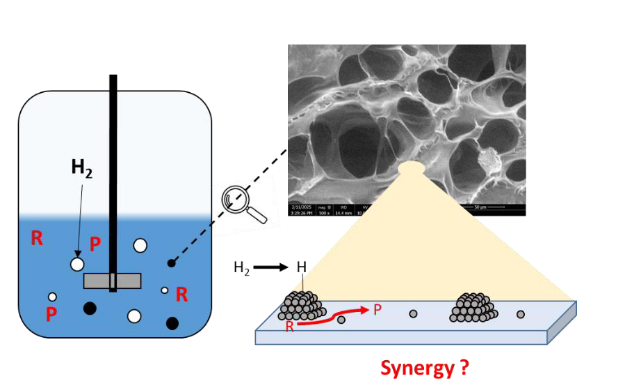
This project will therefore explore an innovative approach: introducing controlled disorder in Ni- and Ru-based catalysts
supported on hierarchical porous materials such as carbides. The objective is to study the synergies between metallic
species of different sizes2-4 and the disordered structure of the support,5 on catalytic performance in hydrogenation
reactions such as CO2 reduction (Figure 1).
The internship will involve:
• Synthesis of hierarchical molybdenum carbide,
combining shaping of biosourced polymers by
the freeze-casting process with a subsequent
carbonization step.6
• Metal deposition either during support
synthesis or via impregnation and colloidal
methods, enabling precise control of particle
size and composition,
• Characterization of materials by electron
microscopies (SEM, STEM), spectroscopies
(XPS, Raman, DRIFTS), thermal (TGA, DSC) and
textural analysis,
• Catalytic evaluation in hydrogenation
reactions, establishing structure–activity
relationships.
This multidisciplinary work will provide new design principles for more efficient and sustainable hydrogenation
catalysts, while offering broad training in materials chemistry, heterogeneous catalysis, and advanced characterization
techniques.
References:
1. A. Wang et al., Nat. Rev. Chem., 2018, 2, 65–81.
2. A. Simonov, A.L. Goodwin, Nat. Rev. Chem. 2020, 4, 657-673.
3. P. Serp, Nanoscale, 2021, 13, 5985-6004.
Areas of expertise:
Porous materials, CO2 hydrogenation, carbides
Required skills for the internship:
Background in physics or chemistry, knowledge in catalysis will be advantageous