
DEVELOPMENT OF AMBIDENTATE NHC-BASED BIS(DITHIOLENE) LIGANDS WITH 5 STABLE REDOX STATES
CHEMISTRY & GREEN CHEMISTRY
Lab: LCC
Duration: NanoX master Internship (8 months part-time in-lab immersion)
Latest starting date: 05/10/2026
Localisation: Laboratoire de chimie de Coordination du CNRS (LCC-CNRS)
205 route de Narbonne - BP44099
31077 Toulouse cedex 4 - FRANCE
Supervisors:
Dmitry VALYAEV dmitry.valyaev@lcc-toulouse.fr
Vincent CÉSAR vincent.cesar@lcc-toulouse.fr
This research master's degree project could be followed by a PhD
Work package:
Redox-active ligands are pivotal in materials chemistry, catalysis, and bioinorganic chemistry, enabling tunable electronic, magnetic, and conductive properties through reversible electron transfer. Among them, dithiolene units stand out for their exceptional redox versatility, stability across multiple oxidation states, and ability to delocalize charge via π-conjugation.[1] In particular, Janus-type bis(dithiolene) ligands are interesting as conjugated bridging organic moieties between redox-active metal centers, as they may potentially mediate or even participate in metal/metal electronic coupling.[2]
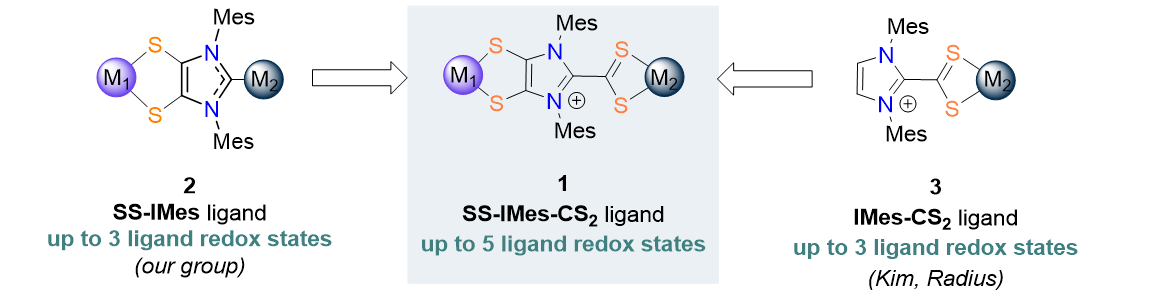
In this context, we propose to develop the bridging, ambidentate bis(dithiolene) ligand 1, composed of a 1,2-dithiolene and a 1,1-dithiolene units fused through a N-Heterocyclic carbene scaffold, and to study its coordination chemistry and redox behavior. Ligand 1 is formally composed by merging the ambidentate, redox-active dithiolene-NHC 2, currently under study in our group,[3] with the NHC-CS2 adduct 3, whose redox-active behavior was recently unveiled.[4] It is anticipated that ligand 1 will accommodate up to five stable redox states, a notable occurrence given its diminutive size.
This project is multidisciplinary in nature and will combine organic and organometallic synthesis, advanced spectroscopic (NMR, ESR, UV-Vis, NIR etc.) characterization and electrochemical techniques. DFT calculations will complement and support the experimental analysis of their electronic structure, to draw structure/reactivity relationships.
References:
References:
[1] (a) R. Kato, “Conducting Metal Dithiolene Complexes: Structural and Electronic Properties” Chem. Rev. 2004, 104, 5319–5346. doi (b) B. Ding, M. B. Solomon, C. F. Leong, D. M. D’Alessandro, “Redox-active ligands: Recent advances towards their incorporation into coordination polymers and metal-organic frameworks” Coord. Chem. Rev. 2021, 439, 213891. doi
[2] A. Vacher, Y. Le Gal, T. Roisnel, V. Dorcet, T. Devic, F. Barrière, D. Lorcy, “Electronic Communication within Flexible Bisdithiolene Ligands Bridging Molybdenum Centers” Organometallics 2019, 38, 4399–4408 and references therein. doi
[3] V. Timofeeva, L. Vendier, A. Sournia-Saquet, V. Maurel, O. Baslé, D. A. Valyaev, V. César, “Merging Dithiolene and NHC Chemistries: En Route to Redox-Active Ambidentate Ligands”, manuscript under preparation.
[4] (a) M. S. Luff, K. Oppel, I. Krummenacher, H. Braunschweig, U. Radius, “Radical anions of 1,1-azoliumdithiocarboxylates” Chemical Communications 2024, 60, 14447–14450. doi (b) S. Park, J.-Y. Hwang, J. Shin, Y. Kim, “N-Heterocyclic Carbene-Derived Carbon Disulfide Radical Ligands for Palladium Diradicals” J. Am. Chem. Soc. 2024, 146, 28508–28515. doi
Areas of expertise:
N-heterocyclic carbenes, sulfur ligands, ligand design, redox properties, polymetallic complexes, DFT calculations
Required skills for the internship:
Good knowledge in organic chemistry, organometallic chemistry, and advanced characterization techniques (multinuclear NMR, X-Ray diffraction, electrochemistry, EPR spectroscopy …). Schlenk line technique, glove box.