
EXCITON TRANSFER IN HYBRID CATALYTIC SYSTEMS
CHEMISTRY & GREEN CHEMISTRY
Lab: LPCNO
Duration: NanoX master Internship (8 months part-time in-lab immersion)
Latest starting date: 05/10/2026
Localisation: Laboratory of Physics and Chemistry of Nano-Objects ( LPCNO)
INSA, 135, av. de Rangueil
31400 TOULOUSE - FRANCE
Supervisors:
Simon TRICARD tricard@insa-toulouse.fr
Edwin A. Baquero eabaquerov@unal.edu.co
This research master's degree project could be followed by a PhD
Work package:
Catalysis is a fundamental pillar of the chemical industry and is crucial for the transition to alternative renewable energy
sources. Metal nanoparticles (NPs) are of particular interest in catalysis thanks to their high surface area, and the ability to
tune their composition, morphology and functionalization. Controlling the activity and selectivity of metal NPs is a long-
standing objective, aimed at maximizing productivity while avoiding side reactions. A variety of strategies has been developed,
ranging from ligand design to selective active site poisoning, alloying, and metal-support interactions. A promising strategy
involves manipulating the charge polarization of metal centers to enhance catalytic performance.
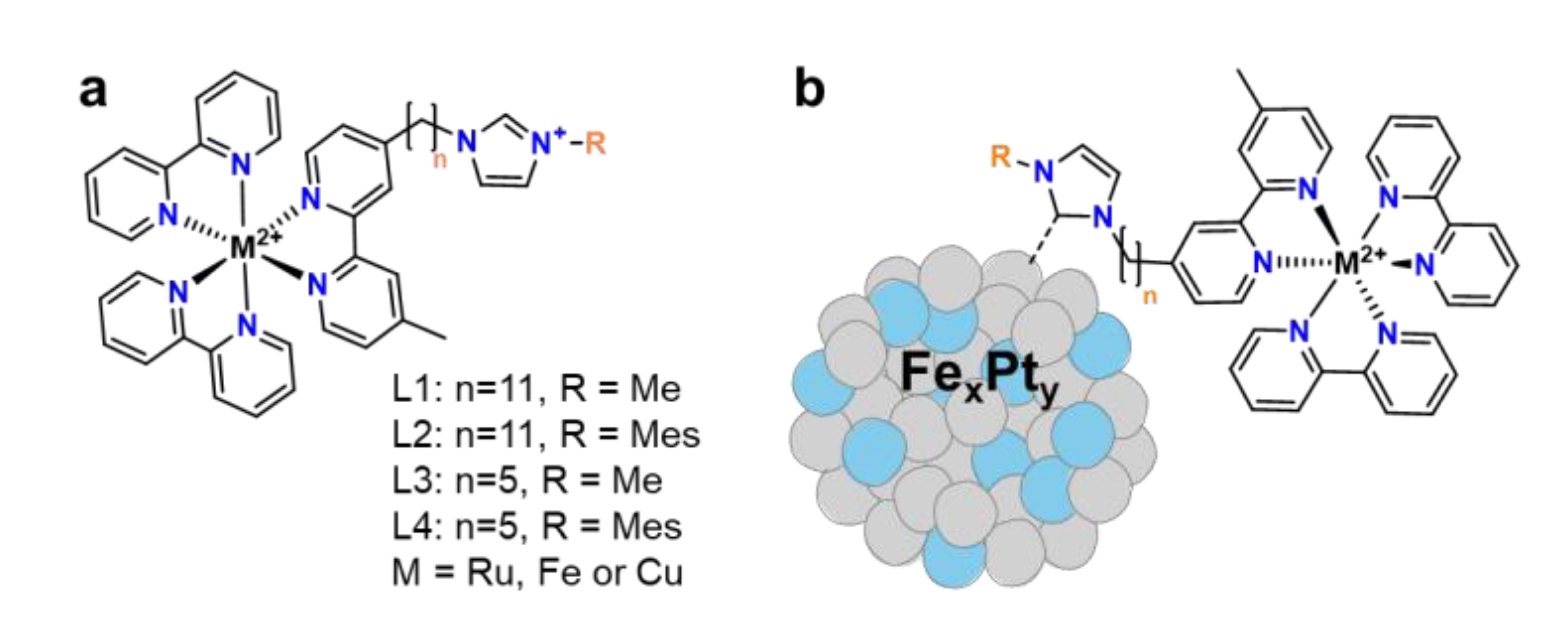
The internship project aims at demonstrating the ability of exciton transfer from molecular antennas to metal nanoparticles
in hybrid systems, and to valorize it for tuning catalytic reactions using light irradiation.
The goal is to develop a proof of concept of polarization of the metal NP triggered by an exciton transfer, i.e. an energy transfer
starting from an electron-hole pair formation, from a molecular antenna present in the vicinity of the NP. Hybrid systems that
combine the two building blocks will be synthesized. The metal NP will be the effective catalyst. The antenna will be a species
able to generate an exciton under irradiation in the visible range. It will be linked to the NP surface by coordination chemistry.
A main objective is to improve catalytic efficiency, thanks to activation by light, while diluting the noble metal by first-row
transition metals in bimetallic NPs. The experimental parameters controlling the energy transfer between the antenna and the
NP will be investigated. The reactivity of such generated high-energy surfaces will be studied in dehydrogenation reactions,
with goals including improvement of the catalytic performance, decrease of the reaction temperatures, and minimization of
noble metal utilization.
The internship will be co-supervised by Simon Tricard, a CNRS research director at LPCNO, and Edwin A. Baquero, an associate
professor at the National University of Colombia. It will take place in the Nanochemistry team of LPCNO, and will combine
nanochemistry (vacuum ramp, glove box), microscopy (TEM, AFM), spectroscopy (IR, UV-Vis, XPS, NMR) structural studies
(XRD, SAXS) and catalytic studies (photoirradiation, GCMS).
References:
References:
- Suárez-Riaño O. et al. Exploring 5-Hydroxymethylfurfural Hydrogenation Pathways Using NHC-Stabilized Water-Soluble
Nanoparticles of Various Metals and Alloys, Green Chem. 2025, 27, 10582–10597.
- Marchenko N. et al. Coordination Bonds as a Tool for Tuning Photoconductance in Nanostructured Hybrid Materials Made
of Molecular Antennas and Metal Nanoparticles, Mater. Horiz. 2025, 12, 3429–3435.
- Suárez-Riaño O et al. Preferential Reduction of 2-Phenylpyridine under D2 : Palladium Nanoparticles Stabilized by N -
Heterocyclic Carbenes Prefer D2 to H2, Nano Lett. 2026, 26, 4936–4943.
Areas of expertise:
Nanochemistry, coordination chemistry, photo-catalysis
Required skills for the internship:
Chemistry