
LCC website LCC A MPHIPHILIC POLYMERIC DIRHODIUM (II) NANOREACTORS FOR AQUEOUS BIPHASIC CATALYSIS
CHEMISTRY & GREEN CHEMISTRY
Lab: LCC
Duration: NanoX master Internship (8 months part-time in-lab immersion)
Latest starting date: 05/10/2026
Localisation: Laboratoire de Chimie de Coordination du CNRS
205 route de Narbonne
31400 TOULOUSE - FRANCE
Supervisors:
Agnès LABANDE agnes.labande@lcc-toulouse.fr
Eric DEYDIER eric.deydier@iut-tlse3.fr
Work package:
In the context of sustainable development, it is now essential to consider the recovery and recycling of catalysts.
Indeed, rhodium is one of the rarest elements on earth, and wherever unreplaceable as catalyst, strategies to use
less, more efficiently, and to recycle it are needed for potential industrial applications. [1] Micellar aqueous biphasic
catalysis offers a very interesting solution, but it suffers from a number of disadvantages, such as swelling of the
micelle by the solvents/reagents, preventing efficient recycling. One promising solution, that has already been used
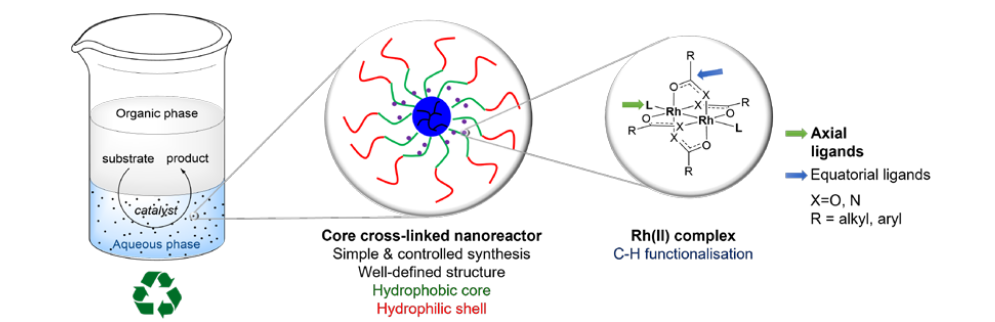
efficiently in the team with other transition metal-catalysed reactions, [2] is to develop 'core-shell' nanoreactors by
controlled polymerisation and final cross-linking of the micelle. These consist of a cross-linked hydrophobic core,
where the catalysts are located, and a hydrophilic peripheral layer for water dispersion.
The aim of this project is to apply this methodology to dirhodium(II) C-H functionalisation catalysis with diazo
compounds. The performances of dirhodium(II) catalysts are still unchallenged in terms of versatility and
efficiency.[3] These complexes bear four bridging (equatorial) ligands and two axial positions able to coordinate
ligands and substrates for catalysis. Thus, their incorporation into nanoreactors will be done through binding onto
one axial site. [1] The metal-containing nanoreactors will then be evaluated in aqueous biphasic catalysis.
This multi-disciplinary internship will enable the candidate to acquire skills in various areas, and will call on several
characterisation techniques such as multidimensional NMR, mass spectrometry, dynamic light scattering (DLS),
transmission electron microscopy (TEM), etc.
References:
References:
[1] N. R. Candeias et al., Org. Biomol. Chem. 2012, 10, 3357-3378.
[2] a) X. Zhang et al., Chem.-Eur. J. 2014, 20, 15505 ; b) E. Lobry et al., J. Catal. 2016, 164, 172 ; c) S. S. Sambou et al., Catal. Sci.
Technol. 2021, 11, 6811-6824.
[3] a) H.M.L. Davies, K. Liao, Nat. Rev. Chem. 2019, 3, 347-360. b) Y. Deng et al., Curr. Org. Chem. 2016, 20, 61-81. c) I. Ruzhylo
et al., ChemCatChem 2024, 17, e202400874
Areas of expertise:
Polymerization; Catalysis; Recycling; Dirhodium; C-H functionalization
Required skills for the internship:
Organic synthesis; organometallic chemistry; knowledge in polymerization will be appreciated