
PHOSPHORUS DENDRIMERS AS NANOMETRIC SCAFFOLDS FOR ANTI-INFECTIVE AGENTS
CHEMISTRY & GREEN CHEMISTRY
Lab: LCC
Duration: NanoX master Internship (8 months part-time in-lab immersion)
Latest starting date: 05/10/2026
Localisation: Laboratoire de chimie de coordination du CNRS
205 Rte de Narbonne, 31077 Toulouse
Supervisors:
Valérie MARAVAL valerie.maraval@lcc-toulouse.fr
Vania BERNARDES - GÉNISSON vania.bernardes-genisson@lcc-toulouse.fr
Work package:
Dendrimers are highly branched, tree-like macromolecules built around a multivalent core and composed of successive generations of branches terminated by surface functional groups. Their stepwise synthesis provides precise control over their size, architecture, and surface chemistry, resulting in perfectly defined molecular structures, unlike conventional polymers. Owing to these unique features, dendrimers have attracted considerable interest over the past decades in fields ranging from catalysis and materials science to nanomedicine.
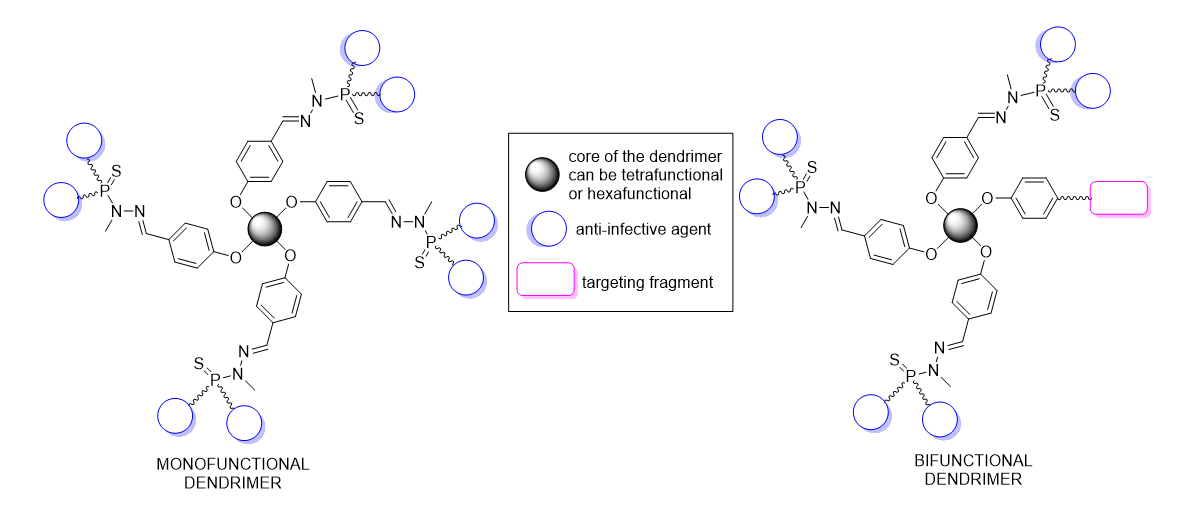
Our research group has developed a strong expertise in the design, synthesis, and characterization of phosphorus dendrimers, a versatile family of dendritic nanostructures that can be readily functionalized with a wide variety of molecular entities. Phosphorus dendrimers have demonstrated excellent biocompatibility and remarkable therapeutic potential. Some surface-functionalized phosphorus dendrimers exhibit intrinsic biological activity,1 whereas others have been successfully employed by our group as nanometric platforms for the covalent attachment of drugs.2 This latter topic has been the focus of a PhD thesis that will be defended in November 2026. Promising results have been obtained in this work toward the development of new dendrimer-based anti-infective nanoplatforms, providing a strong foundation for pursuing our research in this area.3
The objective of this Master’s internship is to design and synthesize new families of phosphorus dendrimers functionalized with anti-infective agents. The project will first focus on the preparation of monofunctional dendrimers bearing a single therapeutic agent. It will then be extended to bifunctional dendrimers incorporating either (i) two distinct anti-infective agents to investigate potential synergistic therapeutic effects, or (ii) an anti-infective agent combined with a targeting ligand capable of recognizing specific cell populations, with the aim of enhancing the selective delivery of the therapeutic nanovector to its site of action. The biological evaluation of the synthesized dendrimers will be performed through collaborations with different partners.
The student will gain experience in multistep organic synthesis, dendrimer chemistry, purification and characterization techniques (1H, 13C, 31P NMR spectroscopy, mass spectrometry, chromatography), and will work at the interface of organic chemistry, nanoscience, and biology within a multidisciplinary research environment.
References:
1. a) S.M. Mignani et al. Biomacromolecules 2021, 22, 2659-2675; b) E. Apartsin et al. Biomacromolecules 2023, 24, 3215-3227.
2. N. El Brahmi et al., Nanoscale 2015, 7, 3915-3922.
3. C. Aparici et al. submitted for publication.
Areas of expertise:
Dendrimers, nanovectors, anti-infectious drugs
Required skills for the internship:
The applicants should have a good background in organic chemistry and a strong interest for nanoscience and medicinal chemistry. The following skills are expected from the candidates:
- Have a solid understanding of organic chemistry and common laboratory techniques.
- Be motivated to carry out multistep synthesis and purification of classical organic compounds and macromolecules.
- Be familiar with basic analytical techniques such as NMR spectroscopy, chromatography, and mass spectrometry (or willing to learn them).
- Demonstrate good experimental skills, scientific rigor, and attention to detail.
- Be able to work both independently and as part of a multidisciplinary research team.
- Possess good communication skills and a sufficient level of English to read the scientific literature and present research results.