
PHOTOACTIVE FE COMPLEXES BASED ON STRONGLY DONATING PHOSPHONIUM YLIDE LIGANDS
CHEMISTRY & GREEN CHEMISTRY
Lab: LCC
Duration: NanoX master Internship (8 months part-time in-lab immersion)
Latest starting date: 05/10/2026
Localisation: LCC-CNRS – University of Toulouse
205 route de Narbonne, 31077 Toulouse cedex 4 – FRANCE
Supervisors:
Yves CANAC yves.canac@lcc-toulouse.fr
Olivier BASLÉ olivier.basle@lcc-toulouse.fr
This research master's degree project could be followed by a PhD
Work package:
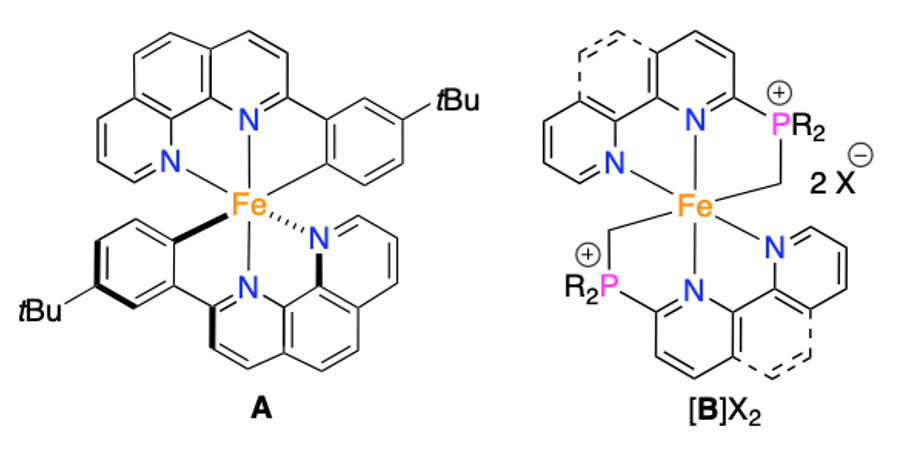
Photoactive transition-metal complexes with long-lived excited states are key components for photocatalysis, solar energy conversion, and optoelectronic applications. While Ru, Os, and Ir complexes exhibit excellent photophysical properties, their scarcity and cost have driven the search for sustainable alternatives based on earth-abundant metals such as Fe.[1] However, the practical use of Fe complexes is hindered by the ultrafast deactivation of MLCT excited states through low-lying metal-centered states. To address this challenge, ligand design has centered on strengthening the ligand field and rigidifying the coordination environment. N-Heterocyclic carbenes, mesoionic carbenes, π-donating amido ligands, and cyclometalated frameworks have progressively extended MLCT lifetimes from the femtosecond to the nanosecond regime,[2] ultimately enabling near-infrared MLCT emission in the bis-cyclometalated Fe(II) complex A.[3] Building on these advances, we will investigate phosphonium ylides as a new class of strongly σ-donating and readily tunable carbon ligands for Fe(II) complexes of type [B]X₂. Their remarkable donor properties and demonstrated performance in Ru(II)- and Ir(III)-based photocatalytic systems suggest that they could provide an attractive alternative to cyclometalated ligands for tuning the electronic structure of Fe complexes and extending MLCT excited-state lifetimes
References:
[1] (a) Wenger, O. S. J. Am. Chem. Soc. 2018, 140, 13522. (b) Wegeberg, C.; Wenger, O. S. J. Am. Chem. Soc. Au, 2021, 1, 1860. (c) Huang, T.; Du, P.; Lin, Y. M. Chin. J. Chem. 2025, 43, 2566. [2] (a) Braun, J. D.; Lozada, I. B.; Kolodziej, C.; Burda, C.; Newman, K. M. E.; Lierop, J.; Davis, R. L.; Herbert, D. E. Nat. Chem. 2019, 11, 1144. (b) Paulus, B. C.; Adelman, S. L.; Jamula, L. L.; McCusker, J. K. Nature, 2020, 582, 214. (c) Genovese, S.; Giorgianni, F.; Amadeo, A.; Serroni, S.; Campagna, S. Photochem. 2026, 6, 2. [3] Leis, W.; Argüello Cordero, M. A.; Lochbrunner, S.; Schubert, H.; Berkefeld, A. J. Am. Chem. Soc. 2022, 144, 1169. [4] (a) Fayafrou, O.; Lognon, E.; Duhayon, C.; Sortais, J. B.; Monari, A.; Baslé, O.; Canac, Y. Chem. Commun. 2024, 601, 13602. (b) Fayafrou, O.; Zanzi, J.; Duhayon, C.; Sortais, J. B. ; Baslé, O.; Canac, Y. Chem. Commun. 2025, 61, 9932. (c) Fayafrou, O.; Busson, L.; Duhayon, C.; Sortais, J. B.; Auffrant, A.; Baslé, O.; Canac, Y. Inorg. Chem. 2026, doi.org/10.1021/acs.inorgchem.6c02308.
Areas of expertise:
Carbenes, phosphonium ylides, ligand design, iron complex, luminescence
Synthetic chemistry, coordination chemistry, photophysics, electrochemistry, photocatalysis
Required skills for the internship:
Good knowledge in organic synthesis, organometallic chemistry, and advanced characterization techniques (multinuclear NMR, X-Ray diffraction, MS, UV-Vis, IR,...)