
QUANTITATIVE CHARACTERIZATION OF MOLECULAR TRANSPORT IN THE ENVIEW COLON-ON-CHIP PLATFORM – DEVELOPPING
NANOSCIENCE
Lab: LPCNO
Duration: NanoX master Internship (8 months part-time in-lab immersion)
Latest starting date: 05/10/2026
Localisation: LAAS-CNRS 7 Av. du Colonel Roche, 31400 Toulouse
Supervisors:
Laurent MALAQUIN laurent.malaquin@laas.fr
Audrey FERRAND audrey.ferrand@inserm.fr
Work package:
Microphysiological systems offer the possibility of reproducing key structural, mechanical and fluidic features of
human tissues under controlled experimental conditions. In this context, the LAAS-CNRS and I2MC teams
(Toulouse, France) have jointly developed EnView, a microfluidic platform designed for the long-term culture and
imaging of human colonic epithelial monolayers.
The EnView microphysiological platform was developed to reproduce key features of the human colonic
epithelium, including crypt-scale topography, a hydrogel-based extracellular matrix and independent perfusion of
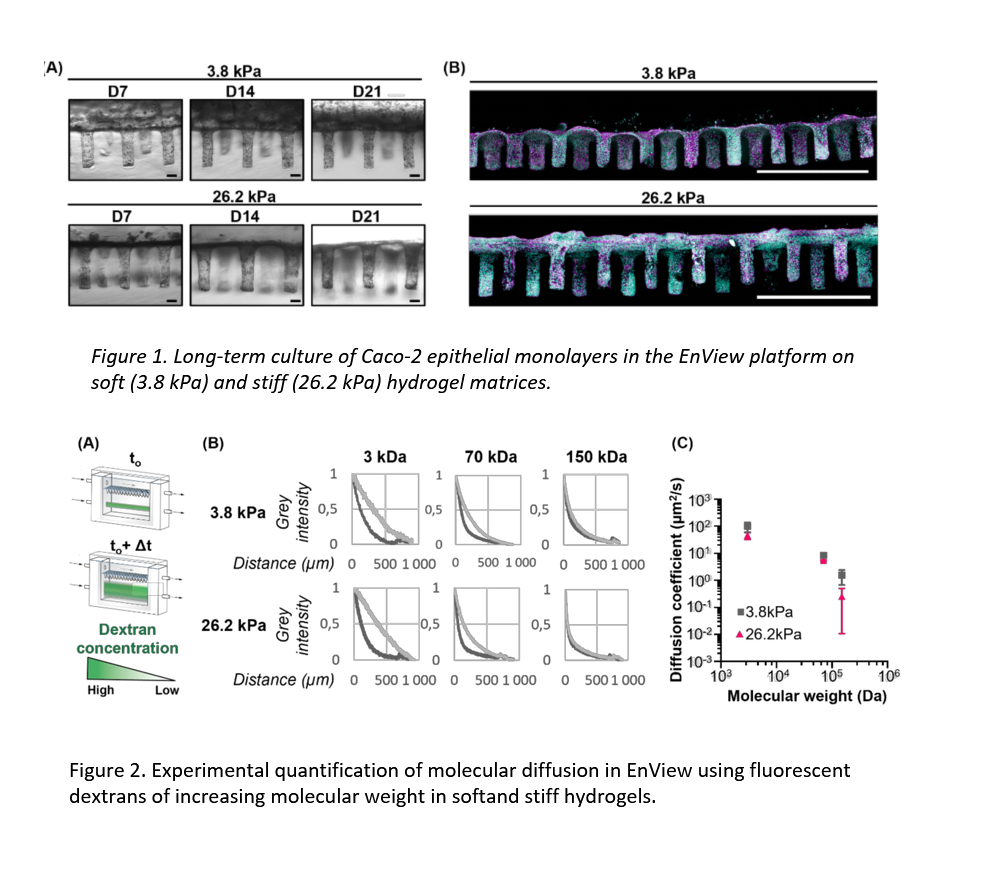
luminal and stromal compartments. The platform has already been validated using Caco-2 epithelial cells cultured
under continuous perfusion for up to 21 days (Fig.1) . These cells form polarized epithelial monolayers and display
matrix stiffness-dependent morphology and maturation-associated features.
Preliminary experiments using fluorescent dextrans showed that molecular transport through the matrix depends
strongly on molecular size and hydrogel properties. These first results provide the basis for a more comprehensive
and predictive investigation of molecular delivery within the platform (Fig.2) .
The main objective of this internship will be to establish and validate a numerical model of molecular diffusion in
the EnView system. The model will describe the transport of soluble compounds from the perfused stromal
compartment, through the hydrogel matrix, toward the epithelial interface. It will integrate the actual geometry of
the device, hydrogel-specific transport properties and the contribution of the epithelial barrier.
Experimental diffusion measurements will be performed using fluorescent probes of different molecular weights.
The imaging and data-analysis workflow will be optimized to extract complete spatiotemporal concentration
profiles rather than relying solely on the position of a diffusion front. These experimental data will be used to
determine effective diffusion coefficients, calibrate the numerical model and assess its predictive capacity.
First validations have proven the relevance of this model with hydrogel materials. The methodology will then be
applied to devices containing epithelial cultures. Comparisons between acellular and epithelialized devices will
make it possible to distinguish the contribution of the hydrogel matrix from that of the cellular barrier. The model
will be used to predict the concentration and exposure kinetics effectively experienced by the cells after delivery
of soluble molecules through the stromal compartment.
In the longer term, this combined experimental and computational approach will support the implementation of
the EnView platform with primary epithelial cells derived from patients. By quantifying and controlling the
exposure of patient-derived tissues to cytokines, growth factors or therapeutic compounds, the project will
contribute to the development of more predictive models for precision medicine and personalized assessment of
treatment responses.
Main work packages
WP1 – Experimental characterization of molecular diffusion
Diffusion experiments will be performed in EnView devices using fluorescent probes covering different molecular
weights. The student will optimize image acquisition, fluorescence calibration and quantitative analysis of spatial
and temporal concentration profiles. Measurements will first be carried out in acellular hydrogel devices to
determine effective diffusion coefficients and characteristic transport times.
Depending on the progress of the project, different hydrogel matrices, including GelMA and collagen-based
photocrosslinkable materials, may be investigated.
WP2 – Development and validation of a numerical transport model
A transient numerical model will be developed using finite-element simulations. The model will reproduce the
geometry of the EnView platform and describe molecular transport from the stromal channel through the hydrogel
toward the epithelial interface. Experimental concentration profiles will be used to calibrate and validate the
model.
The numerical framework will be used to evaluate the effects of molecular size, hydrogel composition, device
geometry and perfusion conditions. It will also provide estimates of the concentration reached at the epithelial
interface and the time required to achieve a defined cellular exposure.
WP3 – Molecular transport in epithelial and patient-derived cultures
The validated methodology will be applied to EnView devices containing epithelial monolayers.
By comparing acellular and cell-containing devices, the student will quantify the additional transport resistance
associated with the epithelial barrier. The model will be extended to include an effective epithelial permeability
and will be confronted with experimental measurements.
The ultimate objective will be to prepare the transfer of this methodology to primary epithelial cells derived from
patients. This will enable controlled exposure of patient-specific tissues to soluble mediators or therapeutic
compounds and support future applications of the EnView platform in precision medicine.
References:
References:
D. Rojas Garcia et al., 2026, Lab On a Chip, accepted
Areas of expertise:
Microphysiological systems; colon-on-chip; molecular diffusion; numerical modelling;
finite-element simulations; hydrogels; epithelial barrier; patient-derived cells; precision
medicine; fluorescence microscopy; image analysis.
Required skills for the internship:
Background in physics, physical chemistry, materials science, biomedical engineering or
a related discipline. Interest in numerical modelling, quantitative experiments and
interdisciplinary research is essential.
Basic knowledge of diffusion, transport phenomena, image analysis or programming
would be advantageous. Experience with COMSOL Multiphysics, Python, MATLAB or
ImageJ would be appreciated but is not mandatory.