
SYNTHESIS AND CHARACTERIZATION OF CHIRAL LUMINESCENT COORDINATION COMPOUNDS EXHIBITING A WHITE CIRCULARY POLARIZED LUMINESCENCE
CHEMISTRY & GREEN CHEMISTRY
Lab: LCC
Duration: NanoX master Internship (8 months part-time in-lab immersion)
Latest starting date: 05/10/2026
Localisation: Laboratoire de chimie de Coordination du CNRS (LCC-CNRS)
205 route de Narbonne - BP44099
31077 Toulouse cedex 4 - FRANCE
Laboratory of Physics and Chemistry of Nano-Objects ( LPCNO)
INSA, 135, av. de Rangueil
31400 TOULOUSE - FRANCE
Supervisors:
Émilie DELAHAYE emilie.delahaye@lcc-toulouse.fr
Delphine LAGARDE delphine.lagarde@insa-toulouse.fr
Work package:
Chiral luminophores can emit light with a different intensity in the left and right circular polarization components. This property, called circularly polarized luminescence (CPL), is particularly interesting for applications in telecommunications, information storage or even to fight against counterfeiting. Luminophores involve organic, inorganic or hybrid as is the case with coordination networks.1,2
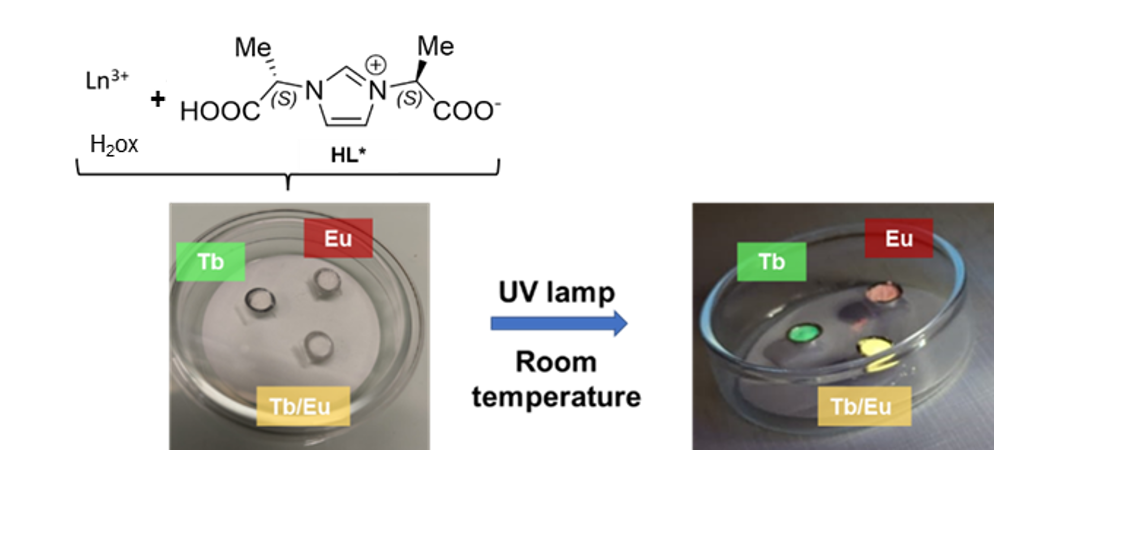
The compounds that we develop are of that latter type and are obtained in solvothermal conditions through association of chiral imidazolium ligands (noted as HL*), of oxalic acid and lanthanides ions. These synthesis conditions allow the formation of [Ln2(L*)2(ox)2(H2O)2] networks ions exhibiting at room temperature a green luminescence when Ln = Tb3+or a red luminescence when Ln = Eu3+. A yellow luminescence is observable when Tb3+ and Eu3+ are mixed at different ratio (see figure).
The objective of this internship will be to achieve a material that emits a white light with large CPL activity. This will be obtained by adjusting the composition and ratio in lanthanides ions. The student in charge of this project will perform the synthesis and the characterization of these materials. This first part will be carried out at LCC. In a second part, the optical properties of these compounds will be studied. This part will be carried out at LPCNO and will include both the study of their luminescence properties and their CPL activities. This project aims at establishing a correlation between the optical properties, especially the CPL activity, and the chemical characteristics of the coordination compounds.
References:
(1) Hao, T.; Xu, B.; Wang, X.; Zheng, H.; Li, S.; Wang, F.; Zhang, J. Enhanced Circularly Polarized Luminescence in Rare-Earth MOFs via Framework Chirality and Host–Guest Energy Transfer. Polyoxometalates 2025. https://doi.org/10.26599/POM.2025.9140095.
(2) Luo, X.-Y.; Pan, M. Metal-Organic Materials with Circularly Polarized Luminescence. Coord. Chem. Rev. 2022, 468, 214640. https://doi.org/10.1016/j.ccr.2022.214640.
Areas of expertise:
Material science, coordination chemistry, optical properties
Required skills for the internship:
Physicist with an interest in optics and not afraid by chemistry (the synthesis are easy to carry out) or a chemist who wants to go beyond synthesis and wants to study physical properties of their compounds.