Christophe GATEL – CEMES
Nanotechnologies have become central to fields ranging from medicine to artificial intelligence, enabling dramatic increases in computational power and data storage. A key challenge is to identify, measure and control the physical phenomena within individual nanocomponents under real operating conditions. Spatially and time-resolved mapping of local electric and magnetic fields, correlated with structure and chemical composition, would be highly valuable for both academic and industrial research in the design and production of new nanodevices with unique and optimized properties. However, it is extremely difficult to access the distribution of electromagnetic fields at the nanometric scale, and especially their dynamics, within these nanostructures during their operation.
Transmission electron microscopy (TEM) is uniquely suited to address this challenge, combining sub-ångström spatial resolution, atomic-scale chemical sensitivity, and compatibility with in situ stimuli. In particular, off-axis electron holography enables quantitative mapping of electrostatic potentials and magnetic fields with sub-nanometer resolution. At CEMES, dedicated instrumental developments have enabled original studies of MOS nanocapacitors, multilayer dielectric stacks, and ferroelectric tunnel junctions, including investigations of industrial devices. However, these studies have so far been limited to static or slowly evolving systems.
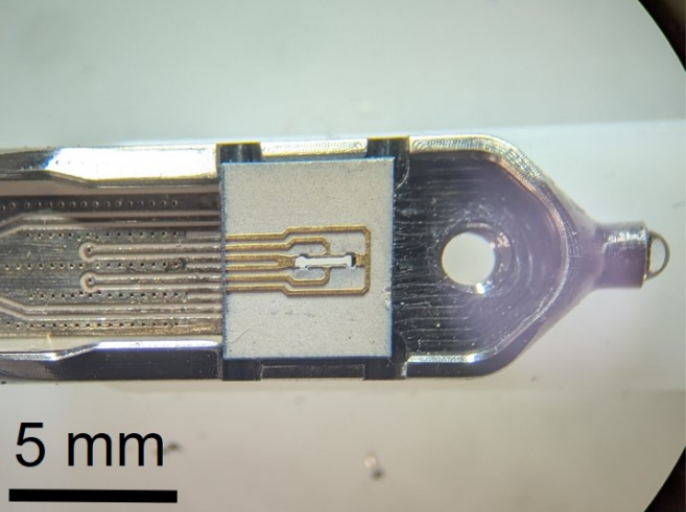
The TEMPO project aims to overcome this limitation by developing time-resolved TEM experiments based on purely electrical excitation, spanning timescales from seconds down to 100 ps. The approach relies on an innovative pump–probe scheme: one RF holder injects a high-frequency electrical signal (up to several GHz) into the nanodevice, while a second holder modulates the electron beam using an ultrafast deflection system synchronized with the excitation. By stroboscopically accumulating images at a fixed phase of the excitation cycle, dynamic processes such as charge trapping, ferroelectric polarization switching, or magnetic texture evolution can be probed without modifying the electron source.
The project includes optimization of the beam deflector to achieve 100 ps temporal resolution, acquisition of synchronized dual-output RF generators, and full control of the RF experimental chain. Ultimately, TEMPO will enable the first time-resolved electron holography experiments on fully operating nanosystems.