
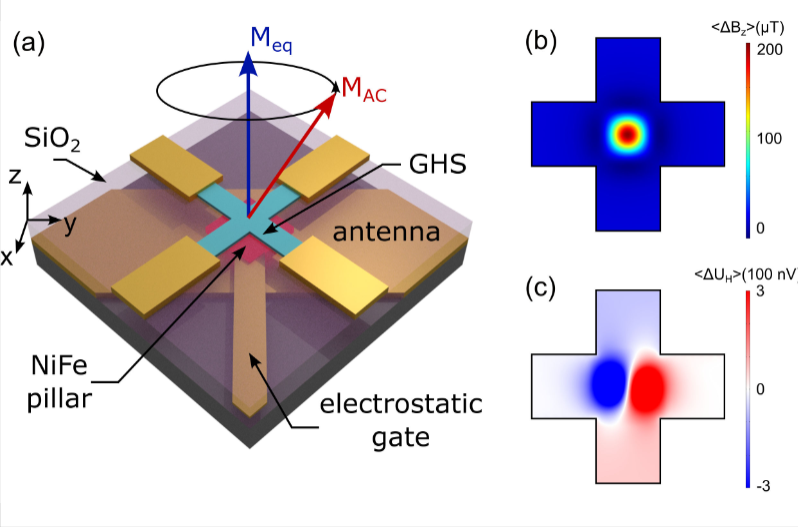

MAGHALLOR II project aims to establish graphene Hall sensors (GHS) as a new class of advanced magnetic field sensors capable of quantifying inhomogeneous magnetic fields below the micro-Tesla at micro and nanoscale levels. Compared to existing technologies like conventional semiconductors-based Hall Effect Sensors, micro superconducting quantum interference devices, diamond nitrogen vacancies-based sensors, tunnel or giant magnetoresistance devices or magnetic force microscope, GHSs offer a promising, non-invasive, cost-effective, easy-to-operate and highly-energy efficient alternative with broad operational ranges in temperature and applied background magnetic fields. Successful completion of MAGHALLOR II is expected to significantly enhance magnetic field resolution and acquisition time at the nano-scale, impacting many fundamental and technological fields. These include studies of ferro and ferrimagnetic nanomaterial such as the recently discovered ferromagnetic van der Waals materials, imaging of magnetic domains or superconducting vortices with a scanning Hall probe microscope, detection of the ferromagnetic resonance or spin wave propagation in the GHz range in spintronics and magnonic nanodevices, as well as biosensing and medical applications such as magneto-cardiography or magnetoencephalography.
Three main objectives will be tackled within MAGHALLOR II: (i) Developing quantitative numerical models to predict GHS’s responses to inhomogeneous magnetic fields and determine the best experimental conditions for optimized signal-to-noise ratio and linearity, facilitating quantitative measurements; (ii) Demonstrating the capability of GHS for quantitative magnetometry under various operational conditions on model nanomagnets synthesized by physical deposition and van der Waals ferromagnets; (iii) For the first time, employing a Hall sensor to detect small microwave magnetic fields generated during ferromagnetic resonance in nanomagnets and during spin wave propagation in waveguides.