
EXSOTIP
EXOTIC SPIN-ORBIT COUPLING FOR SPIN TORQUES AND INTERLAYER PROXIMITY ENGINEERING
Recent advances in spintronics have revolutionized magnetic random-access memory (MRAM) technologies, transitioning from spin-transfer torque MRAMs to spin-orbit torque (SOT) MRAMs for improved energy efficiency, scalability, and endurance. SOT mechanisms rely on charge-to-spin conversion via the spin Hall effect in heavy metals or the Rashba-Edelstein effect at interfacest to manipulate the magnetization of an adjacent ferromagnet (FM).
Topological insulators (TIs), with their robust spin-polarized surface states, have become key candidates for efficient SOT generation.
However, challenges such as bulk state interference and interfacial intermixing with ferromagnetic layers limit their potential. In this context, the EXSOTIP project will explore two strategies based on van der Waals heterostructures:
– The first one aims at integrating TIs with 2D ferromagnets to maintain sharp interfaces with enhanced spin transparency.
– The second one relies on using a graphene interlayer to decouple the TI from the FMs, with the intention to preserve interfacial quality and to enhance charge-to-spin conversion.
These approaches not only address interface challenges inherent to TIs but also open new avenues for exploring proximity-induced effects in graphene-based heterostructures, offering tunable and efficient SOT for next-generation spintronic devices. 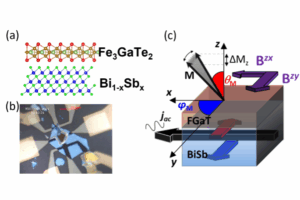
(a) 2DFM/TI van der Waals heterostructure. (b) hBN/Fe3GaTe2/Pt microdevice realized by polymer-assisted dry transfer. (c) Schematic of the magnetization oscillation induced by SOT. This oscillation will be characterized by two experimental techniques: Harmonic Hall Analysis and Kerr microscopy.
Research project selected under the 2025 call for proposals
Principal Investigator : Thomas GUILLET
Involved Teams :
- LPCNO/Nanomag
Research project selected under the 2025 call for proposals
Type of project : Disruptive Project
Date (start/end) : 2025